
How Private Money Lending Works in Real Estate Investing
Learn about borrowing money to invest in real estate opportunities.
Private money lending has become one of the most powerful tools for real estate investors looking to move quickly, scale efficiently, and bypass traditional bank financing. Whether you are a fix and flip investor, a rental property buyer or just getting started, understanding how private money works can open doors to deals you might otherwise miss.
We will be breaking down exactly how private money lending works, how deals are structured and how both borrowers and lenders can benefit. Additionally, we will go over a few real world examples to show private money lending in action.

What Is Private Money Lending?
Private money lending is a form of real estate financing where an individual, not a bank or institutional lender, provides funds for an investment deal. Instead of relying on strict underwriting criteria such as credit scores and debt-to-income ratios, private money lenders focus primarily on:

These loans are typically secured by real estate, making them less risky for the lender compared to unsecured investments.
1.
Investor Finds a Deal
The process starts when an investor identifies a property with strong profit potential, often below market value or in need of renovation.
2.
Investor Connects with a Private Lender
Private lenders can come from personal networks including friends and family, business relationships, real estate groups and repeat lending partners.
3.
Terms are Negotiated
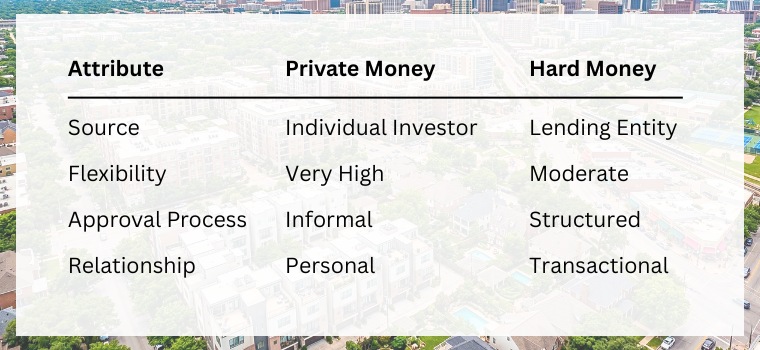
One of the biggest advantages of private money is flexibility. Terms are fully customizable, including interest rates, loan duration (often 6 to 24 months), points also known as origination fees, repayment structure and profit sharing agreements in certain situations.
4.
Loan is Secured by Real Estate
Most private money loans are backed by the property itself using a mortgage or deed of trust. This gives the lender legal protection if the borrower defaults.
5.
Funds are Disbursed
The lender provides capital for property acquisition and/or renovations which can at times be via a staged draw.
6.
Exit Strategy is Executed
The investor repays the loan through one of two primary strategies including selling the property for a profit (fix-and-flip) or refinancing into a long term loan (buy and hold strategy).
Key Benefits and Features of Private Money Loans
Flexible Terms - Unlike banks, private lenders can structure deals creatively based on mutual agreement.
Fast Closings - Deals can often close in a matter of days, giving investors a competitive edge.
Relationship Based Lending - Trust, communication, and track record matter more than rigid financial metrics.
Asset-Focused Approval - The deal itself often carries more weight than the borrower’s credit profile.
Real World Examples of Private Money Lending
Fix-and-Flip Deal
An investor finds a distressed property for $200,000 that needs $40,000 in renovations. After repairs, the property is expected to sell for $325,000.
* Private lender funds: $240,000 (purchase + rehab)
* Terms: 10% interest, 12-month term
* Outcome: Property sells for $325,000
After repaying the lender and costs, the investor walks away with a strong profit—while the lender earns a solid return secured by the asset.
Rental Property
An investor uses private money to acquire and renovate a rental property.
* Purchase: $180,000
* Rehab: $30,000
* After repair value: $270,000
The investor refinances with a traditional lender, pays off the private lender and holds the property as a long term rental, recycling their capital into the next deal.
Repeat Investor Relationship
An experienced investor builds a relationship with a private lender who funds multiple deals.
* Faster approvals
* Pre-agreed terms
* Ongoing capital access
This allows the investor to scale quickly while the lender generates consistent, passive returns.
Benefits of Private Money Lending
Private money lending offers significant advantages for both borrowers and lenders, particularly in the real estate investing ecosystem. For borrowers, one of the biggest benefits is speed as access to capital is often much faster than with traditional banks, allowing investors to act quickly, especially on time sensitive opportunities. In addition, private money loans are highly flexible with terms that can be customized to fit the specific deal rather than rigid institutional guidelines. This flexibility makes it easier to structure creative financing solutions and compete in competitive markets. Borrowers also benefit from a more accessible approval process, as private lenders typically focus on the strength of the deal rather than strict credit requirements.
Risks to Consider
While private money lending can be highly effective, it does come with risks that both parties should carefully evaluate. For borrowers, the cost of capital is typically higher than traditional financing, and loan terms are often shorter, which can create pressure to execute the investment strategy quickly and efficiently. If the exit strategy is delayed or fails, the financial consequences can be significant.
From the lender’s perspective, the primary risks include borrower default, inaccurate property valuations, and potential mismanagement of the project. Even though these loans are usually secured by real estate, unforeseen issues can impact the property’s value or the investor’s ability to complete the project successfully. As a result, proper due diligence and conservative underwriting are essential.
Best Practices for Success
Success with private money lending largely depends on preparation, transparency and strong relationships. Investors should clearly present their deals with detailed numbers, including purchase price, renovation costs, projected value and exit strategy. Having a well defined plan for how the loan will be repaid is critical to building lender confidence.
Equally important is the use of proper legal documentation to protect both parties and ensure clarity in the agreement. Ongoing communication throughout the project helps maintain trust and prevents misunderstandings. Over time, investors who consistently deliver on their promises can build long term relationships with private lenders, creating a reliable source of funding for future deals.
Private money lending is a powerful financing strategy that gives real estate investors speed, flexibility and scalability that traditional lending simply can’t match. When used correctly, it can help investors close more deals, grow their portfolios and build lasting partnerships with those who provided the capital needed for your transaction. If you are serious about real estate investing, understanding how private money works can be a viable option for various real estate opportunities.
Mortgage Insight:
Purchasing a Home with a Conventional Loan
VA Loan Success Story with Eric and Denise
How a VA Loan in Ocala, FL changed a Family's Financial Future
Can I Use My VA Loan in a Chapter 13 Bankruptcy?
Can a Fiance or Kids be on a VA Loan?
Veterans Who Buy Homes See Far Higher Net Worth Than Renters
How Much Mortgage Insurance Can I Save with a VA Loan?
Duplex Property in Fort Lauderdale Quadruples in Value and Leaves a Nest Egg to the Heirs
How a California Remote Worker Obtained a Mortgage to Relocate to Boca Raton, FL
What's the Average Mortgage in Fort Lauderdale, FL?
What Factors are in my Credit Score for a Mortgage?
What Documents Do You Need for a No Income Verification Mortgage?
Restaurant Owner Obtains Self-Employed Home Loan
Can a General Contractor Obtain a No Income Verification Mortgage?
Is a HELOC or a Cash Out Refinance Better to Pay for a New Roof?
Can a Collection Prevent Me from Getting a Mortgage?
Do I Have to Make Mortgage Payments if I Lose My Job?
How to Rent Out Your Investment Property
How Private Money Works in Real Estate Investing
What Portion of a Mortgage Payment Goes Towards Insurance
How Much Cash Can I Take Out of My Home?
Top 5 Purposes for a Cash-Out Refinance
Is My VA Disability Income Enough for a VA Loan?

Your mortgage journey.
Various loan type options including:
Conventional loan
FHA loan
VA loan
Self-employed loan options
No income verification for investors
Benefits of Homeownership
Homeownership is a significant milestone and a decision that offers many advantages. In addition to providing a place to call your own, owning a home brings financial stability, personal fulfillment, and a sense of belonging. Mortgage Group has been helping individuals and families obtain homeownership, guiding them through the process and obtaining referrals to help their family and friends accomplish the same.

Purchase
Get pre-approved to purchase your first home, second home or upcoming investment property.
Refinance
Own a property and interested in lowering your payment? Need to take cash out? Refinance with confidence.
Connect with Us
Our experienced team with be happy to speak with you, and walk you through each step of the process.

Providing mortgage solutions to help you with your home.
Mortgages can be complicated and have many moving parts. Let our team help you!
Contact Us
It only takes a few moments to reach out and have an initial conversation.
Know the Next Steps
Our team will work with you to find the best way to achieve your home loan goals.
Find Your Home and Get Your Loan
Our team will be prepared to move with the next steps once you have secured your home purchase contract.
Houses
Townhomes

Condos

Multi-Units




Contact our team today.
1-800-583-5305
© Copyright 2026 E Mortgage Capital, Inc.. All rights reserved.
- 1416824 | E Mortgage Capital, Inc.
Notice To Texas Loan Applicants: Consumers wishing to file a complaint against a mortgage banker, or a licensed mortgage banker residential mortgage loan originator, should complete and send a complaint form to the Texas Department of Savings and Mortgage Lending, 2601 North Lamar, Suite 201, Austin, TX 78705. Complaint forms and instructions may be obtained from the department’s website at www.sml.texas.gov
A toll-free consumer hotline is available at 1-877-276-5550. The department maintains a recovery fund to make payments of certain actual out of pocket damages sustained by borrowers caused by acts of licensed mortgage banker residential mortgage loan originators. A written application for reimbursement from the recovery fund must be filed with and investigated by the department prior to the payment of a claim. For more information about the recovery fund, please consult the department’s website at
www.sml.texas.gov