
Is My VA Disability Income Enough for a VA Loan?
Learn how about using your VA loan and what you may qualify for with your VA disability income.
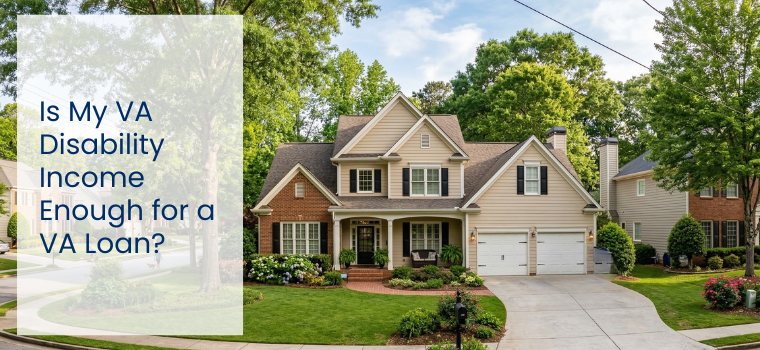
Buying a home is a huge milestone, and for veterans, it often comes with unique questions. One of the most common questions I hear is: “Is my VA disability income enough to get a VA loan?” The short answer is sometimes yes—but the full story is more nuanced. Understanding how VA loans work, how disability income is viewed, and what factors lenders consider can make the process clearer and less intimidating.
Understanding VA Loans
VA loans are a special type of mortgage backed by the Department of Veterans Affairs. They are designed to help veterans, active-duty service members, and certain surviving spouses buy homes. What makes them stand out is that they are built to be veteran-friendly:
In most cases, there is no down payment required.
There is no private mortgage insurance (PMI).
Interest rates are often lower than conventional loans.
Credit requirements are more flexible, recognizing that life after service can be complex.nd a stable income, this can be beneficial and potentially help if you're looking for a larger loan.
The VA itself doesn’t lend money. Instead, private lenders, such as banks or credit unions, issue the loan while the VA guarantees a portion of it. This guarantee reduces the lender’s risk, making homeownership more accessible to veterans.
How Underwriting Looks at Your VA Disability Income?
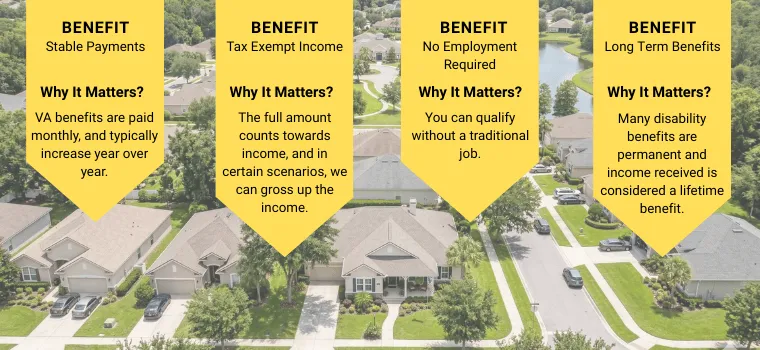
When a VA underwriter reviews your VA mortgage application, they really want to ensure you can reliably make the monthly payments. Your income is a big part of that evaluation, and VA disability benefits count as income. Read on to see as various types of income are treated differently.
VA disability pay is considered stable and guaranteed, especially for veterans with service-connected disabilities. If you are retired from the military or receive Social Security or a pension, these are also counted as stable income sources. Even if your only source of income is VA disability, many veterans can still qualify, depending on the amount and their financial picture.
When VA Disability Income Alone Is Enough?
In certain cases, VA disability income by itself is sufficient to qualify for a VA loan. A prime example is a veteran with a 100% service-connected disability rating. In these cases, lenders view the income as guaranteed for life, and that stability can support a mortgage without needing other income sources.
For veterans with smaller disability benefits or lower ratings, lenders often combine VA disability with other sources like Social Security, a military pension, or retirement pay. This helps ensure the veteran can comfortably manage the mortgage and other living expenses.
A Few Real World Scenarios
To make this more concrete, let’s look at some examples:
Scenario 1: Paul and Judy – 100% Service-Connected Disability
Paul retired from the military after 20 years and has a 100% service-connected disability rating. His monthly VA disability benefits are substantial. Even without other income, Paul qualified for a VA loan and purchased a home in a neighbor neighborhood. The underwriter saw his income as stable and predictable, which made the process straightforward.

Scenario 2: Maria C. – Partial Disability + Pension
Maria retired from the military with a 70% disability rating and also receives retirement pay. By combining her VA disability with her pension, she was able to qualify for a VA loan that allowed her to buy a home for her family. Her experience shows how combining income sources can open the door to homeownership, even if your VA disability benefits alone aren’t enough.
Scenario 3: Kevin B. – VA Disability + Social Security
Kevin receives VA disability and Social Security income. On their own, each income source may not have been enough to comfortably qualify for a home. But together, they provided sufficient monthly income to meet the lender’s requirements. This is a common scenario for veterans who have transitioned to civilian life.
Scenario 4: Lisa S. – Disability Only, Smaller Benefits
Lisa’s VA disability rating is 50%, which means her monthly benefit is modest. On its own, it might not cover the mortgage for her desired home. However, with a small co-borrower income and a low debt-to-income ratio, she was able to secure a VA loan. Lenders will sometimes look at “residual income”—the money left over after living expenses—to determine if a veteran can manage a mortgage even if their income seems low.
What Do Underwriters Look At Beyond Income?
Income is important, but it is not the only factor lenders consider. Other key criteria includes:
Credit Score: VA loans are more flexible than conventional loans, but a good credit score can help secure better interest rates and smoother approval.
Debt-to-Income Ratio (DTI): This compares your monthly debts to your monthly income. Lower DTI ratios make approval easier. VA loans are flexible, but DTI is still important.
Savings and Reserves: While not always required, having savings shows financial stability and can help cover unexpected expenses like home repairs or closing costs.
Even if your VA disability income is the main source, managing debts, improving credit, and maintaining some savings can make the loan approval process smoother.
How VA Disability Helps Beyond Qualifying?
VA disability income doesn’t just help with loan approval—it can also make a home more affordable. Since VA loans don’t require a down payment or PMI, more of your income goes toward the mortgage itself rather than additional fees.
Veterans with service-connected disabilities may also qualify for VA funding fee exemptions. The funding fee can be a significant upfront cost, sometimes thousands of dollars. Veterans with a 100% disability rating usually don’t have to pay it, which saves money and reduces the loan balance.
Steps for Veterans Considering a VA Loan
If you’re thinking about buying a home with your VA disability income, here’s a clear path to follow:
Gather Documentation
Collect your VA disability award letter, Social Security statements, pension information, and any other proof of income. Organized paperwork speeds up the loan process.
Check Your Credit
Know your credit score ahead of time. Even though VA loans are flexible, a higher credit score helps you get better terms and interest rates.
Understand Your Debt-to-Income Ratio
Calculate your monthly debts versus your monthly income. If your DTI is high, paying down small debts or adjusting your budget can improve your approval chances.
Consult a VA Loan Specialist
A lender familiar with VA loans can evaluate your unique situation and tell you whether your VA disability income alone is enough, or if combining income sources might be necessary.
Get Pre-Approved
Pre-approval gives you a realistic understanding of what you can afford and strengthens your position when making an offer on a home.
Making Homeownership Work for You
It’s important to remember that every veteran’s situation is different. Some rely solely on VA disability income, while others have pensions, Social Security, or other sources of income. Even veterans with modest VA benefits can sometimes qualify, especially if their debts are low and their financial profile is strong.
For many veterans, homeownership is more than just buying a property—it’s building a foundation for family life, security, and stability after years of service. Using your VA benefits wisely, including disability income, is a powerful tool in achieving that goal.
Key Takeaways
VA disability income is stable and reliable, which can make it sufficient to qualify for a VA loan, especially at 100% service-connected ratings.
Combining disability income with other sources like Social Security, retirement, or a pension can improve your ability to qualify and secure favorable loan terms.
Lenders consider more than income—they look at credit, debts, and savings—but VA loans are generally more flexible than conventional loans.
Working with a VA loan specialist ensures you understand your options and maximizes the chance of approval.
Buying a home can feel overwhelming, especially when relying on VA disability income; however, your VA service connected benefits are a strong foundation. With careful planning, the right guidance and a clear understanding of your financial picture, homeownership is possible. Veterans across the country, including those relying solely on VA disability or combining it with other income, are finding homes that fit their budgets and lifestyles. Your benefits are earned through service, and using them wisely can make a lifelong dream of owning a home a reality.
Before proceeding, it’s advisable to speak with a training VA loan specialist to determine a suitable route for your scenario. Contact us to discuss next steps with your VA home loan.
Mortgage Insight:
Purchasing a Home with a Conventional Loan
VA Loan Success Story with Eric and Denise
How a VA Loan in Ocala, FL changed a Family's Financial Future
Can I Use My VA Loan in a Chapter 13 Bankruptcy?
Can a Fiance or Kids be on a VA Loan?
Veterans Who Buy Homes See Far Higher Net Worth Than Renters
How Much Mortgage Insurance Can I Save with a VA Loan?
Duplex Property in Fort Lauderdale Quadruples in Value and Leaves a Nest Egg to the Heirs
How a California Remote Worker Obtained a Mortgage to Relocate to Boca Raton, FL
What's the Average Mortgage in Fort Lauderdale, FL?
What Factors are in my Credit Score for a Mortgage?
What Documents Do You Need for a No Income Verification Mortgage?
Restaurant Owner Obtains Self-Employed Home Loan
Can a General Contractor Obtain a No Income Verification Mortgage?
Is a HELOC or a Cash Out Refinance Better to Pay for a New Roof?
Can a Collection Prevent Me from Getting a Mortgage?
Do I Have to Make Mortgage Payments if I Lose My Job?
How to Rent Out Your Investment Property
How Private Money Works in Real Estate Investing
What Portion of a Mortgage Payment Goes Towards Insurance
How Much Cash Can I Take Out of My Home?
Top 5 Purposes for a Cash-Out Refinance

Your mortgage journey.
Various loan type options including:
Conventional loan
FHA loan
VA loan
Self-employed loan options
No income verification for investors
Benefits of Homeownership
Homeownership is a significant milestone and a decision that offers many advantages. In addition to providing a place to call your own, owning a home brings financial stability, personal fulfillment, and a sense of belonging. Mortgage Group has been helping individuals and families obtain homeownership, guiding them through the process and obtaining referrals to help their family and friends accomplish the same.

Purchase
Get pre-approved to purchase your first home, second home or upcoming investment property.
Refinance
Own a property and interested in lowering your payment? Need to take cash out? Refinance with confidence.
Connect with Us
Our experienced team with be happy to speak with you, and walk you through each step of the process.

Providing mortgage solutions to help you with your home.
Mortgages can be complicated and have many moving parts. Let our team help you!
Contact Us
It only takes a few moments to reach out and have an initial conversation.
Know the Next Steps
Our team will work with you to find the best way to achieve your home loan goals.
Find Your Home and Get Your Loan
Our team will be prepared to move with the next steps once you have secured your home purchase contract.
Houses
Townhomes
Condos

Multi-Units




Contact our team today.
1-800-583-5305
© Copyright 2026 E Mortgage Capital, Inc.. All rights reserved.
- 1416824 | E Mortgage Capital, Inc.
Notice To Texas Loan Applicants: Consumers wishing to file a complaint against a mortgage banker, or a licensed mortgage banker residential mortgage loan originator, should complete and send a complaint form to the Texas Department of Savings and Mortgage Lending, 2601 North Lamar, Suite 201, Austin, TX 78705. Complaint forms and instructions may be obtained from the department’s website at www.sml.texas.gov
A toll-free consumer hotline is available at 1-877-276-5550. The department maintains a recovery fund to make payments of certain actual out of pocket damages sustained by borrowers caused by acts of licensed mortgage banker residential mortgage loan originators. A written application for reimbursement from the recovery fund must be filed with and investigated by the department prior to the payment of a claim. For more information about the recovery fund, please consult the department’s website at
www.sml.texas.gov