
Florida Bank Statement Loan
Flexible financing options for business owners, independent contractors, freelancers and entrepreneurs seeking a home loan. There's no need for tax returns. Let us qualify you using your bank statements instead.
Check Your Eligibility
Get a Free Consultation
Speak with a Loan Specialist
For many self-employed professionals, qualifying for a traditional mortgage isn't always as straightforward as it is for someone with a W-2 job. Business owners often take advantage of legitimate tax deductions that reduce their taxable income, but those same deductions can make it appear as though they earn less than they actually do. As a result, otherwise qualified borrowers may have difficulty meeting conventional mortgage guidelines.
A Florida bank statement loan offers an alternative path to homeownership by allowing lenders to evaluate income using bank statements instead of tax returns. These loans are designed specifically for self-employed individuals, entrepreneurs, freelancers, independent contractors, and other borrowers whose financial picture isn't fully reflected on a tax return.
What is a Bank Statement Loan?
A bank statement loan is a type of non-qualified mortgage (Non-QM) that uses personal or business bank statements to verify income. Rather than relying solely on tax returns, lenders review deposits over a specified period—typically 12 or 24 months—to determine a borrower's ability to repay the loan.
This approach can provide a more accurate representation of income for self-employed borrowers whose earnings fluctuate or whose tax strategies minimize taxable income.
Bank statement loans are available for purchasing a home, refinancing an existing mortgage, or accessing equity through a cash-out refinance, depending on the lender's program guidelines.
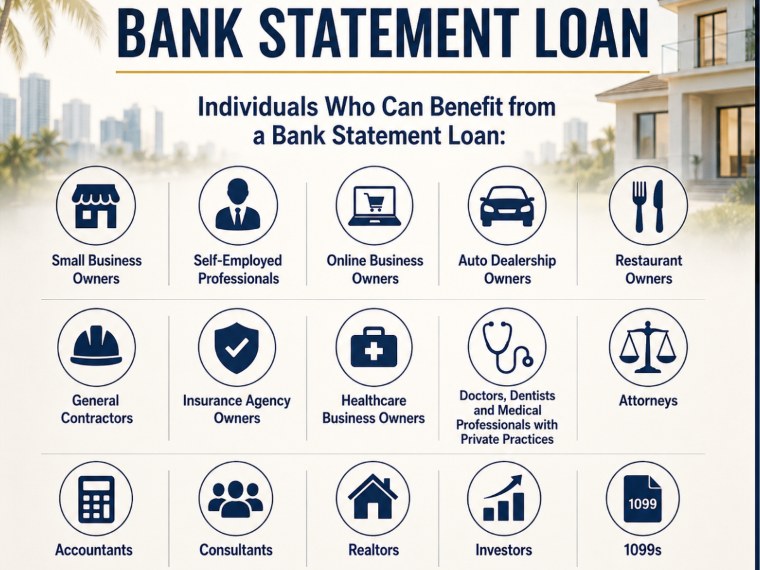
Individuals Who Can Benefit from a Bank Statement Loan:
Small Business Owners
Self-Employed Professionals
Online Business Owners
Auto Dealership Owners
Restaurant Owners
General Contractors
Insurance Agency Owners
Healthcare Business Owners
Doctors, Dentists and Medical Professionals with Private Practices
Attorneys
Accountants
Consultants
Realtors
Investors
1099s
If you've built a successful business but your tax returns don't fully reflect your cash flow, a bank statement loan can be worth exploring.
Why Florida Borrowers Choose Bank Statement Loans?
Florida has one of the nation's largest populations of entrepreneurs and self-employed professionals. From tourism and hospitality businesses to real estate, construction, healthcare, and technology, many Floridians operate businesses with seasonal or variable income.
Traditional mortgage underwriting doesn't always accommodate these unique income patterns. Bank statement loans recognize that successful business owners often have strong cash flow even if their taxable income appears lower due to business deductions.
Whether you are purchasing a primary residence in Orlando, refinancing a home in Tampa, buying a vacation property near the Gulf Coast, or investing in real estate in Miami, bank statement loans may provide greater flexibility than conventional financing, and cut out much of the red tape typically associated with self-employed individuals getting a mortgage. In other words, the process becomes much more straightforward and allows business owners to accomplish their goal!
How is Income Calculated?
One of the biggest differences between a conventional mortgage and a bank statement loan is how income is evaluated.
Instead of reviewing tax returns, lenders examine eligible bank statements to identify consistent deposits. Depending on the loan program, they may review either personal or business bank statements. For business accounts, lenders may apply an expense factor or use additional documentation to estimate business expenses before calculating qualifying income.
Every lender has its own underwriting guidelines, so the documentation requirements and calculation methods may vary. Working with a mortgage professional who regularly handles bank statement loans can help you understand what documentation may be needed and what to expect during the review process.
Advantages of a Bank Statement Loan
For the right borrower, bank statement loans offer several meaningful benefits.
Flexible Income Verification
Rather than relying exclusively on tax returns, lenders consider actual cash deposits that demonstrate ongoing business activity.
Designed for Self-Employed Borrowers
These loans recognize the financial realities of running a business and can provide financing options that better reflect your earning capacity.
Purchase or Refinance
Many bank statement loan programs can be used for purchasing a home, refinancing an existing mortgage, or completing a cash-out refinance, subject to lender guidelines.
Multiple Property Types
Depending on the program, financing may be available for:
Primary residences
Second homes
Vacation properties
Investment properties
Single-family homes
Condominiums
Townhomes
Certain multi-unit properties
Competitive Financing Options
While interest rates and loan terms may differ from conventional mortgages, many borrowers find that the flexibility offered by bank statement loans makes them a practical solution for achieving their homeownership or investment goals.
What Documents May Be Required?
Although documentation requirements vary, borrowers are commonly asked to provide:
12 to 24 months of personal or business bank statements
Government-issued identification
Asset statements
Information regarding business ownership
Proof of reserves, when required
Purchase contract for home purchases
Homeowners insurance information before closing
Additional documentation may be requested based on your individual financial situation.
Tips for Improving Your Chances of Approval
If you're considering a bank statement loan, a few proactive steps may strengthen your application:
Maintain consistent deposits whenever possible.
Keep personal and business finances organized.
Avoid large unexplained deposits that cannot be documented.
Continue making existing debt payments on time.
Save for your down payment, closing costs, and reserve requirements.
Consult with a mortgage professional early in the home-buying process to understand available loan options.
Is a Bank Statement Loan Right for You?
Every borrower's financial situation is unique. A bank statement loan isn't intended to replace conventional financing, but it provides an important alternative for borrowers whose income isn't accurately reflected through traditional documentation.
If you're self-employed, own a successful business, or receive income through nontraditional means, this type of financing may help you qualify for a mortgage that better reflects your true financial picture.
By evaluating income through bank statements instead of relying solely on tax returns, these loans expand home financing opportunities for many hardworking Floridians who might otherwise find the conventional mortgage process challenging.
Before choosing any mortgage product, it's important to compare available loan options, review program requirements, and discuss your goals with a knowledgeable mortgage professional. Understanding how bank statement loans work can help you determine whether they're the right fit for your home purchase or refinance plans and move forward with greater confidence.
Are tax returns required?
No. With a bank statement loan, tax returns are not required for for income qualification.
Can a first-time homebuyer qualify?
Yes, a first-time homebuyer can purchase a primary residence if they have sufficient cash flow utilizing their bank statements. Eligibility will depend on credit, down payment, appraisal, etc.
Is a higher credit score helpful?
Since we are not utilizing tax returns, underwriting will review other elements including your credit. Having good to excellent credit will be more desirable a bank statement loan program. However, we have a variety of programs and can discuss specific scenarios once we speak.
Can I refinance later?
Some borrowers choose to refinance into another mortgage loan in the future if their financial circumstances change and they qualify under different lending guidelines. For example, a business owner may purchase a home now utilizing their business cash flow with a bank statement loan. Then, in a few years, if the property appreciates, the business owner may decide to take out funds with a cashout refinance. At that time, the business owner may consider the same program or perhaps their circumstances are different, and a conventional loan can be explored. With a variety of programs, we can discuss and go over your various options.
Can I purchase a second home or investment property?
Yes, with a bank statement loan, we can look at various options including purchasing a primary residence, second home or investment property.
How many years is the mortgage when obtaining a bank statement loan?
Similar to a traditional 30 year fixed mortgage, homeowners who obtain a bank statement loan will also have a 30 year fixed mortgage.
Can I have an interest only mortgage?
Yes. Some business owners request this for cash flow purposes. For example, various business owners would rather just pay the interest on the mortgage and have the option to pay the principal because they are growing their business. Other business owners purchase property and only intend to keep the home for a few years, and ask about an interest only mortgage to lessen their payment for the duration they own the home.
Is it possibly to have more than one bank statement loan?
Yes, if your business has sufficient cashflow, you can purchase more than one property and have a bank statement loan for each home. Underwriting will review each file independently and allow qualified individuals to build a real estate portfolio and utilize business cashflow to finance it.
How much of a down payment is needed?
Typically, business owners will need at least 10% for a down payment, on a single family home and most townhomes, that will be a primary residence. If it's a condo, it may require more of a down payment depending on the property's criteria. Additionally, second homes and investment properties will typically require a bit more of a down payment. Inquire for details on your specific scenario.
For more information on a bank statement loan, please contact us to discuss your real estate financing needs.
Mortgage Insight:
Purchasing a Home with a Conventional Loan
VA Loan Success Story with Eric and Denise
How a VA Loan in Ocala, FL changed a Family's Financial Future
Can I Use My VA Loan in a Chapter 13 Bankruptcy?
Can a Fiance or Kids be on a VA Loan?
Veterans Who Buy Homes See Far Higher Net Worth Than Renters
How Much Mortgage Insurance Can I Save with a VA Loan?
Duplex Property in Fort Lauderdale Quadruples in Value and Leaves a Nest Egg to the Heirs
How a California Remote Worker Obtained a Mortgage to Relocate to Boca Raton, FL
What's the Average Mortgage in Fort Lauderdale, FL?
What Factors are in my Credit Score for a Mortgage?
What Documents Do You Need for a No Income Verification Mortgage?
Restaurant Owner Obtains Self-Employed Home Loan
Can a General Contractor Obtain a No Income Verification Mortgage?
Is a HELOC or a Cash Out Refinance Better to Pay for a New Roof?
Can a Collection Prevent Me from Getting a Mortgage?
Do I Have to Make Mortgage Payments if I Lose My Job?
How to Rent Out Your Investment Property
How Private Money Works in Real Estate Investing
What Portion of a Mortgage Payment Goes Towards Insurance
How Much Cash Can I Take Out of My Home?
Top 5 Purposes for a Cash-Out Refinance
Is My VA Disability Income Enough for a VA Loan?
Can I Use a VA Loan More Than One Time?
Helping Renters Build Credit with These 4 Strategies
How to Get a Mortgage Pre-Approval Letter
What Fannie Mae’s Crypto Move Means for Homebuyers?
Can a Canadian Citizen Get a U.S. Mortgage?
What to Know When Purchasing a Duplex with a Mortgage
Can Refinancing Your Car Help You Qualify for a Mortgage?
How Business Owners Can Qualify for an Interest Only Home Loan?

Your mortgage journey.
Various loan type options including:
Conventional loan
FHA loan
VA loan
Self-employed loan options
No income verification for investors
Benefits of Homeownership
Homeownership is a significant milestone and a decision that offers many advantages. In addition to providing a place to call your own, owning a home brings financial stability, personal fulfillment, and a sense of belonging. Mortgage Group has been helping individuals and families obtain homeownership, guiding them through the process and obtaining referrals to help their family and friends accomplish the same.

Purchase
Get pre-approved to purchase your first home, second home or upcoming investment property.
Refinance
Own a property and interested in lowering your payment? Need to take cash out? Refinance with confidence.
Connect with Us
Our experienced team with be happy to speak with you, and walk you through each step of the process.

Providing mortgage solutions to help you with your home.
Mortgages can be complicated and have many moving parts. Let our team help you!
Contact Us
It only takes a few moments to reach out and have an initial conversation.
Know the Next Steps
Our team will work with you to find the best way to achieve your home loan goals.
Find Your Home and Get Your Loan
Our team will be prepared to move with the next steps once you have secured your home purchase contract.
Houses
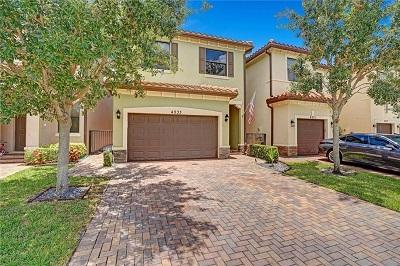
Townhomes
Condos

Multi-Units




Contact our team today.
1-800-583-5305
© Copyright 2026 E Mortgage Capital, Inc.. All rights reserved.
- 1416824 | E Mortgage Capital, Inc.
Notice To Texas Loan Applicants: Consumers wishing to file a complaint against a mortgage banker, or a licensed mortgage banker residential mortgage loan originator, should complete and send a complaint form to the Texas Department of Savings and Mortgage Lending, 2601 North Lamar, Suite 201, Austin, TX 78705. Complaint forms and instructions may be obtained from the department’s website at www.sml.texas.gov
A toll-free consumer hotline is available at 1-877-276-5550. The department maintains a recovery fund to make payments of certain actual out of pocket damages sustained by borrowers caused by acts of licensed mortgage banker residential mortgage loan originators. A written application for reimbursement from the recovery fund must be filed with and investigated by the department prior to the payment of a claim. For more information about the recovery fund, please consult the department’s website at
www.sml.texas.gov